The Ecology of Formation: How Environments Build Identity (Before You Ever Choose)

The Premise: Formation Precedes Choice
Most people evaluate their lives as if identity began with conscious decisions.
Scripture presents a different order.
Formation comes first. Choice comes later.
Before a person has language for truth, they are already:
absorbing environments
interpreting experiences
forming internal agreements
This is why Scripture places such weight on early formation:
“Train up a child in the way he should go; even when he is old he will not depart from it.” — Proverbs 22:6
This is not merely instruction. It is imprinting.
What is consistently practiced, modeled, and reinforced in early stages becomes the default path of identity.
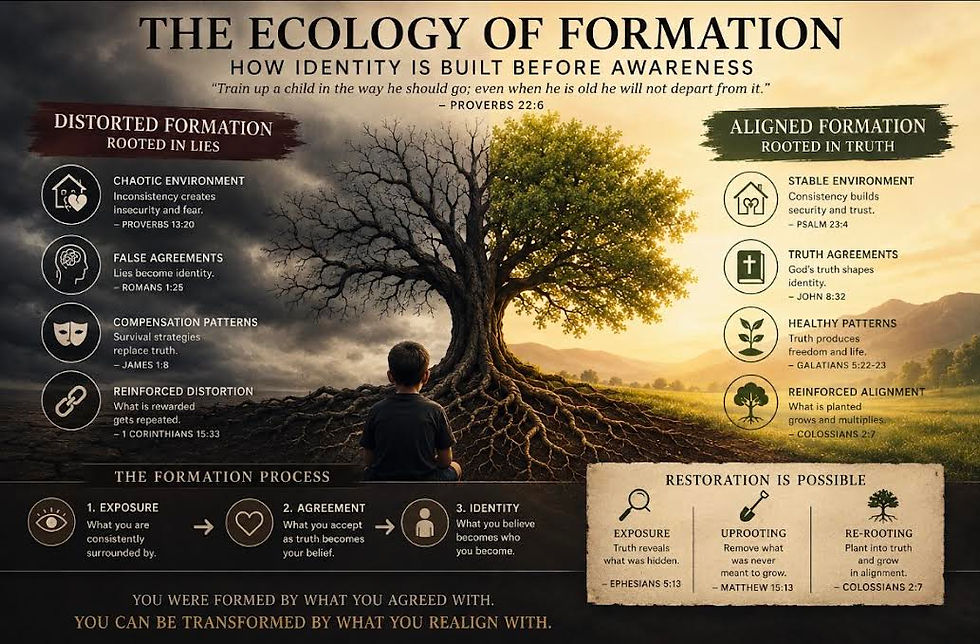
The Pre-Conscious Window: Where Identity Takes Shape
There is a stage of development where:
logic is not fully formed
discernment is immature
dependence on environment is total
In this stage, a person does not evaluate truth they absorb it.
Scripture alludes to this vulnerability:
“Like newborn infants, long for the pure spiritual milk…” — 1 Peter 2:2
This reveals something critical:
what is fed becomes what is desired
what is repeated becomes what is normalized
During this window, identity is not chosen, it is conditioned.
The Mechanism of Formation: Exposure → Agreement → Identity
Biblical transformation and distortion follow the same pathway:
What you consistently behold, you eventually become aligned with.
1. Exposure (What you are surrounded by)
emotional tone of the home
consistency or unpredictability
presence or absence of structure
2. Agreement (What you internalize as truth)
“This is what love feels like”
“This is how conflict is handled”
“This is who I am in relation to others”
3. Identity (What stabilizes as your default)
patterns of response
relational posture
internal narrative
Scripture confirms this pattern:
“Do not be deceived: ‘Bad company ruins good morals.’” — 1 Corinthians 15:33
And:
“Whoever walks with the wise becomes wise…” — Proverbs 13:20
Formation is not abstract, it is relational and environmental.
IV. Environmental Imprinting: When Systems Become Internal
A child does not just live in an environment, they internalize it.
This means:
chaotic environments produce internal chaos
inconsistent environments produce internal instability
regulated environments produce internal stability
Over time, the external system becomes an internal operating system.
This is why a person can leave an environment physically, but still carry its patterns internally.
Scripture describes this internalization:
“Above all else, guard your heart, for everything you do flows from it.” — Proverbs 4:23
The heart becomes the storage system of formation.
Caregivers as Primary Systems of Formation
In early development, caregivers are not just authority figures, they are living ecosystems.
They provide:
emotional regulation
behavioral modeling
structural consistency
Scripture places direct responsibility here:
“Fathers, do not provoke your children to anger, but bring them up in the discipline and instruction of the Lord.” — Ephesians 6:4
Formation is not just what is taught. It is what is:
modeled
tolerated
reinforced
and repeated
Children learn:
how to regulate by being regulated
how to respond by observing response
how to see themselves by how they are treated
The Emergence of Distortion in Formation
When environments lack alignment with truth, identity still forms, but it forms around adaptation.
This is where compensatory identity begins:
performance replaces worth
control replaces safety
avoidance replaces vulnerability
image replaces identity
Scripture describes this exchange:
“They exchanged the truth of God for a lie…” — Romans 1:25
And the result is instability:
“A double-minded man is unstable in all his ways.” — James 1:8
Distortion is not random, it is formed through repeated exposure to misaligned systems.
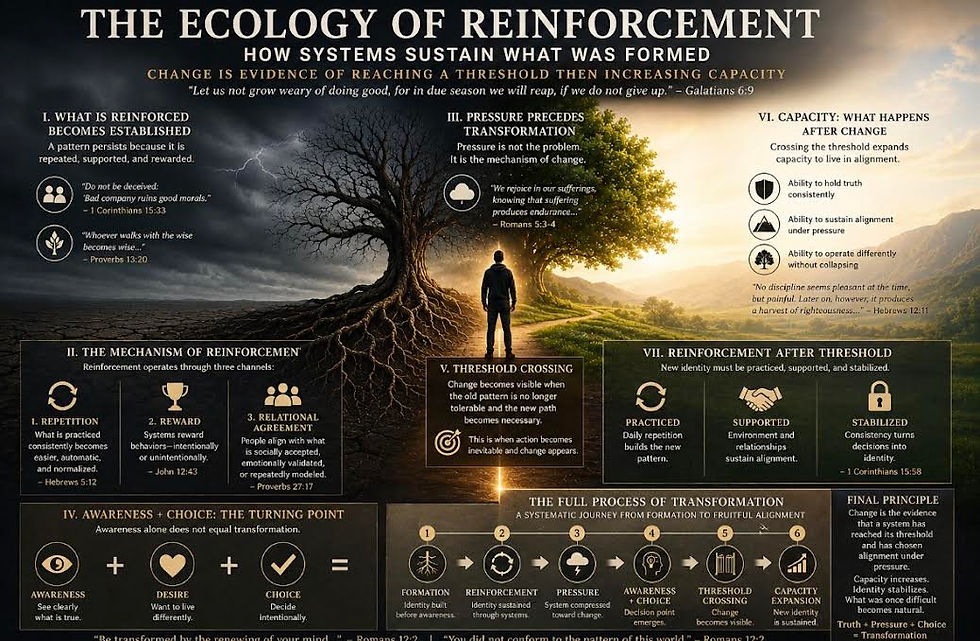
Reinforcement: How Distortion Becomes Identity
Formation does not stop in childhood.
It is reinforced through:
peer environments
educational systems
cultural values
If a distorted pattern is rewarded, it becomes cemented.
For example:
performance rewarded → identity becomes performance-based
emotional suppression normalized → identity becomes disconnected
independence praised excessively → identity becomes isolated
This reflects a core principle:
What a system rewards, it reproduces.
Scripture warns of this reinforcement cycle:
“Do not conform to the pattern of this world…” — Romans 12:2
Because patterns, once reinforced, become difficult to distinguish from identity.
Why Awareness Feels Disruptive
When truth is introduced, it does not initially feel stabilizing, it feels disruptive.
Because it challenges:
long-held beliefs
familiar patterns
internal agreements
This is why many resist transformation.
Not because they do not want truth, but because truth destabilizes what has felt “normal.”
Jesus states:
“You will know the truth, and the truth will set you free.” — John 8:32
But before truth liberates, it exposes.
It reveals:
where identity was formed in error
where alignment was never established
The Role of Structured Re-Formation
Once formation is understood, restoration requires intentional re-formation.
This is not passive.
It requires:
new environments
consistent structure
repeated exposure to truth
Scripture describes this process as renewal:
“Be transformed by the renewing of your mind…” — Romans 12:2
And re-rooting:
“Let your roots grow down into Him, and let your lives be built on Him.” — Colossians 2:7
Re-formation is the intentional rebuilding of:
belief systems
behavioral structures
environmental alignment
Application Within The Root System™
This chapter establishes the second layer of your framework:
Roots (Formation)
beliefs formed before awareness
identity shaped through early agreement
Environment (Reinforcement)
systems that stabilize or distort identity
Structure (Sustainability)
routines and patterns that maintain alignment
Fruit (Expression)
visible outcomes of the internal system
The Goal: Conscious Alignment After Unconscious Formation
Every person begins with unconscious formation.
The goal is to move into:
conscious alignment with truth.
This is maturity.
This is self-governance.
This is what Scripture describes as becoming established:
“So that we may no longer be children… tossed to and fro by the waves…” — Ephesians 4:14
Final Principle
You did not become who you are randomly.
You were formed:
by what surrounded you
by what you experienced
by what you agreed with before you understood
But formation is not final.
What was formed unconsciously can be realigned intentionally.
Because:
Identity is shaped before awareness, stabilized through reinforcement, and transformed through intentional re-formation in truth.

Comments