The Ecology of Alignment: How Identity is Formed, Distorted, and Restored

There is a fundamental misunderstanding that shapes how most people approach growth, behavior, and even healing.
We tend to focus on what is visible.
The behavior
The emotions
The patterns
We often try to correct what we can see, while ignoring what is actually producing it.
But here is the truth:
Nothing you see is the starting point. Everything you see is the result.
If we’re going to talk about real transformation, not temporary behavior shifts, not surface-level improvement; we have to start at the level of ecology.
Format each of your headings below to Heading 2 to keep your post neat and SEO-friendly.
Identity Is Formed in Systems, Not Isolation
No one becomes who they are in a vacuum.
Every person is shaped by a system:
the environment they were raised in
the experiences they encountered
the meanings they attached to those experiences
Over time, these inputs form patterns. Patterns become beliefs. Beliefs stabilize into identity. This is why two people can experience similar situations and walk away with completely different internal worlds. Because identity is not just about what happens to you, it’s about how your system processes and reinforces it, in other words it's a form of conditioning.
The Law of Ecology: Systems Produce Outcomes
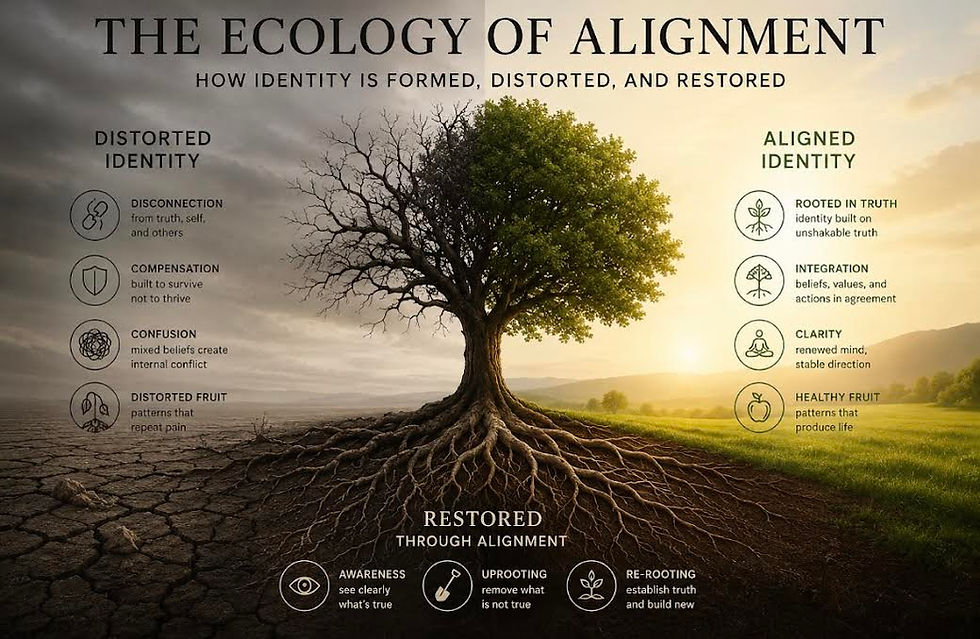
In nature, a tree does not struggle to produce fruit.
It produces based on:
the condition of its roots
the quality of its soil
the consistency of its environment
If the fruit is unhealthy, we don’t shame the tree. We examine the system.
The same principle applies to people.
What we call:
“bad behavior”
“emotional instability”
“inconsistency”
is often just the visible fruit of an invisible system. People are not problems. Systems are.
How Identity Is Actually Formed
Identity forms through repeated agreement with what is experienced as true.
Not necessarily what is true but what feels consistent, reinforced, and real.
This process is shaped by three things:
1. Environment
What surrounds you daily:
stability or chaos
safety or unpredictability
structure or inconsistency
2. Experience
What happens to you:
affirmation or rejection
guidance or neglect
pressure or support
3. Interpretation
What you decide it means:
“I am safe”
“I am alone”
“I have to perform to be valued”
Over time, these interpretations become internal agreements and those agreements shape identity.
The Formation of Distortion
When a system lacks truth, stability, or structure, identity doesn’t stop forming.
It adapts. This is where compensatory identity begins. A person learns to function by building around what’s missing or "compensating".
They may become:
highly independent (because they had to be)
controlling (because unpredictability felt unsafe)
performative (because love felt conditional)
withdrawn (because vulnerability felt costly)
These are not flaws. They are adaptations that once made sense. But over time, what helped you survive can start to misalign you by way of what many call defense mechanisms.
What Is Misalignment?
Misalignment isn’t just being “off.” It’s internal disagreement.
It looks like:
wanting peace but living in chaos
knowing truth but not being able to sustain it
desiring connection but reinforcing distance
This creates internal tension or dissonance because different parts of you are operating under different beliefs. Alignment is not about what you want. It’s about what you agree with.
The Root System™: Understanding Where Change Actually Happens
To change outcomes, we have to understand structure. Think of your life like a tree:
Roots → your beliefs, identity, and what you’re anchored in
Trunk → your structure, routines, and discipline
Fruit → your behavior and results
Most people try to change the fruit. But if the root stays the same, the fruit will grow back the same way. Real change happens at the root.
Restoration Is Not Behavior Modification
You cannot permanently change behavior without changing the system that produces it.
Restoration requires three things:
1. Awareness
Seeing clearly:
what you believe
where it came from
how it’s shaping your life
2. Uprooting
Letting go of false agreements:
beliefs that were formed in dysfunction
patterns that no longer serve truth
3. Re-rooting
Establishing new foundations:
consistent truth
structured support
repeated alignment
This is not instant. It is a process of cultivation.
Why Environment Still Matters (Even as an Adult)
No system stabilizes without intention.
Just like a tree needs:
proper soil
consistent nourishment
protection from harsh conditions
people need regulated environments. This is especially important for children, but it applies to adults as well.
A regulated system provides:
consistency
clarity
emotional stability
structure
Dysregulated environments produce dysregulated outcomes.
This is why your surroundings, relationships, and systems still matter, no matter how “self-aware” you are.
The Goal: Alignment, Not Perfection
The goal isn’t perfection. It’s alignment.
A person who is aligned:
lives in agreement with truth
operates from internal stability
doesn’t rely on constant external correction
They are not driven by survival patterns. They are grounded in identity.
This is what it means to be: rooted and grounded
Final Thought
Every pattern in your life is producing something.
If you don’t like what you see, don’t start with the outcome.
Start with the system.
Because: Identity is formed by what you’ve agreed with, distorted by what you’ve adapted to, and restored by what you realign with.



Comments